Hand-made in the Age of Machines
Group Exhibition Curated by Ricky Francisco
1/28/20264 min read
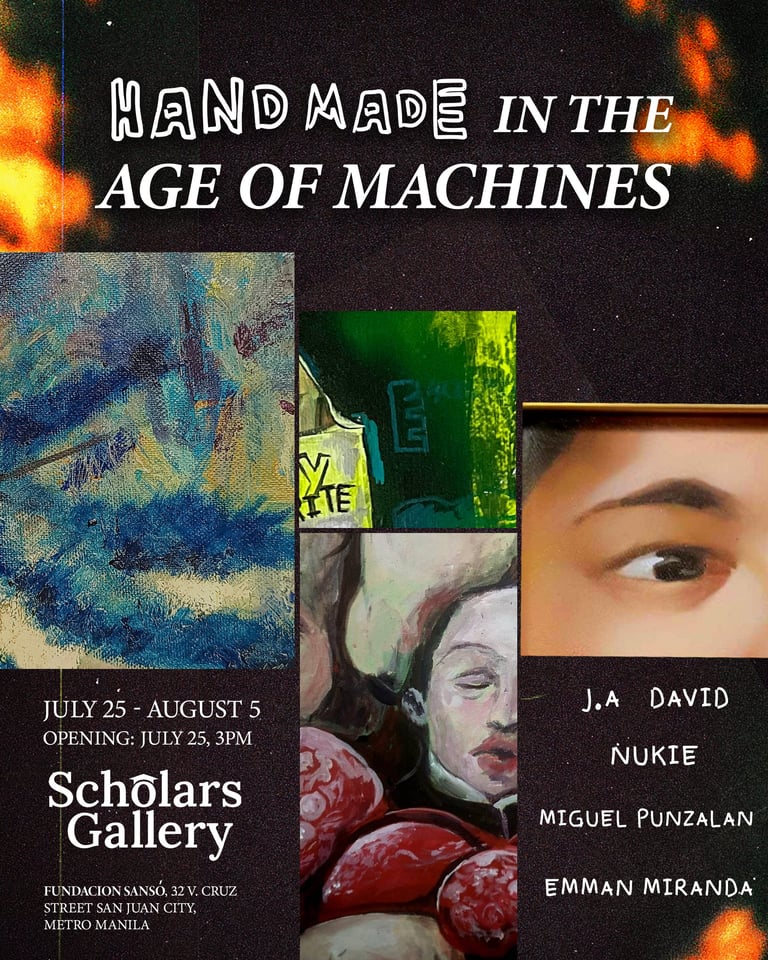
Hand-Made in the Age of Machines
“AI is coming for all of us.”
This slogan burns across social media, a carefully cultivated panic that mixes real disruption with manufactured dread. As layoffs hit creative industries and demand for original work softens, anxiety spreads. People scroll endlessly, drowning in polished but soulless content, while something quieter stirs beneath the noise.
A longing grows, not to reject technology, but to reclaim the friction, imperfection, and humanity of making things with our own hands.
We cannot rewind to some romanticized past. Nor should we. But we can choose how we move forward. In an era of generative AI and infinite algorithmic slop, the most radical act is to reassert the human touch.
This is a call to humanism through craft. Whether with paint on canvas, or digital tools guided by a living hand, we return to painting; slow, imperfect, and undeniably ours. It is an act of remembrance: imagination is not a subscription service. It is a birthright, forged in flesh and experience, not prompt and data center.
By embracing the handmade, we refuse to outsource our vision. We create not for the algorithm, but for ourselves and for others who still hunger for something real.
Artists:
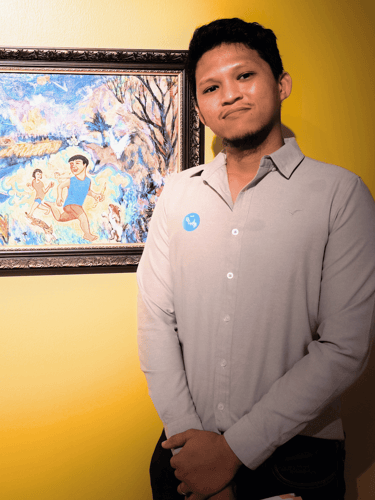
J.A. David
“I create artworks heavily informed by phenomenology, an introspective study of consciousness, and situate it on basic human experience. For this group show, I return to an intimate reflection of places: Lansangan, gubat, bulalakaw. Within these places, a sort of human suffering, cognition, or meditation.”
Nukie
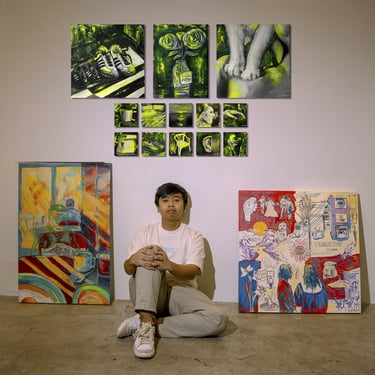
I paint black and gray still lifes of everyday objects that carry the trace of their owner. Through collected and photographed items—shoes, phones, letters, dog paws—I reconstruct fragments of a human life. Neon yellow-green marks the exact points of touch and use, turning each object into evidence of presence and memory. Through them, identity and intimacy remain long after the person is gone.
Technology can generate almost anything these days, but it won't duplicate the lived experience of being human. When my father passed away, I was confronted with his objects as I cleaned out his office. I discovered items he used that I didn't even know he had. Using those objects, I built a portrait of him in my head. Like subtext in cinema, these things say what words and actions don't. Through them, I learned more about my father than from anything he chose to say or show.
Emmanuel Miranda
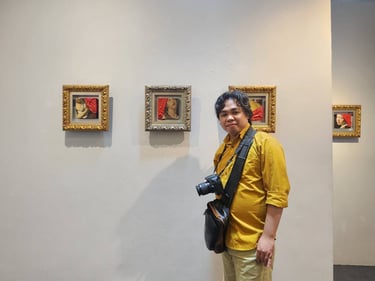
Amorsolo Sneak Peek Portraits
The Amorsolo Sneak Peek Portraits explore the relationship between memory, tradition, and the changing identity of the artist in an age of technological acceleration. The series presents a dual perspective: it invites viewers to look into the past while allowing the past to look back at us.
On one level, these portraits offer a fleeting glimpse of the painting tradition embodied by the old masters—a legacy of discipline, craftsmanship, and technical excellence that is increasingly overshadowed by the rapid pace of contemporary visual culture and artificial intelligence. What was once the foundation of artistic practice now risks becoming a forgotten language.
On another level, the works reverse the gaze. They imagine the past confronting the present, questioning what we, as artists, have become. The gradual departure from rigorous academic training toward a culture centered on self-expression reflects a profound transformation in the purpose and practice of art. Today, with the rise of AI-generated imagery, both traditional and modern art face a common uncertainty: the possibility that human ingenuity, cultivated through years of discipline and lived experience, may be displaced by technological efficiency.
Rather than rejecting innovation, this series invites contemplation. It asks what is lost when artistic knowledge, patience, and craftsmanship are no longer essential to the creative process. Ultimately, the Amorsolo Sneak Peek Portraits serve as a quiet meditation on the enduring value of human creativity and the fragile continuity of artistic tradition in an era defined by artificial intelligence.
Miguel Punzalan
Across Miguel's collection of works, the visceral collapse of distinct forms into a singular, melded mass serves as a hermeneutic mirror to the current algorithmic dawn, shifting the narrative from digital automation to a profound biological overwrite. This is the latent space made physical: a haunting taxonomy where individual sovereignty is no longer the creator of culture, but the raw, compressed training data being scraped and digested into a homogenized, collective soup. Throughout these pieces is an attempt to move past standard anxieties of technology to confront a terrifying post-human reality; one where our shared history is systematically dissolved to form the literal infrastructure for a synthetic intelligence.